

If you’ve started researching how to straighten your teeth, you’ve almost certainly run into the phrase clear aligners vs Invisalign and wondered whether they’re actually two different things. It’s one of the most common questions we hear from patients at Pleasant Smiles Family Dental, so let’s clear it up right away and then walk through the real differences that affect your smile, your budget, and your results.
Quick Answer
Invisalign is not separate from clear aligners. It is the best-known brand of clear aligner. “Clear aligners” is the general category for the see-through plastic trays that gradually straighten teeth, and Invisalign is one specific brand within it, alongside options like ClearCorrect and ClearPath. So the more useful comparison isn’t clear aligners versus Invisalign as rivals. It’s understanding how the different brands and treatment types compare on price, on how closely a dentist watches your care, and on the kinds of cases they can handle.
Are Clear Aligners vs Invisalign the Same Thing?
Here’s the easiest way to think about it. All Invisalign trays are clear aligners, but not all clear aligners are Invisalign, the same way every Kleenex is a tissue, but not every tissue is Kleenex. Invisalign, made by a company called Align Technology, launched back in 1997 and helped make clear aligners popular.
Many people call it the gold standard because of its planning software, its material, and the huge number of cases it has treated. Other brands work the same way: a set of custom trays gently pushes your teeth into place over time.
The difference that matters most for your health is not really the brand. It’s whether a dentist checks your treatment in person or you order it online with no hands-on exam. We’ll come back to that, because it’s important.
How Do Clear Aligners Work?
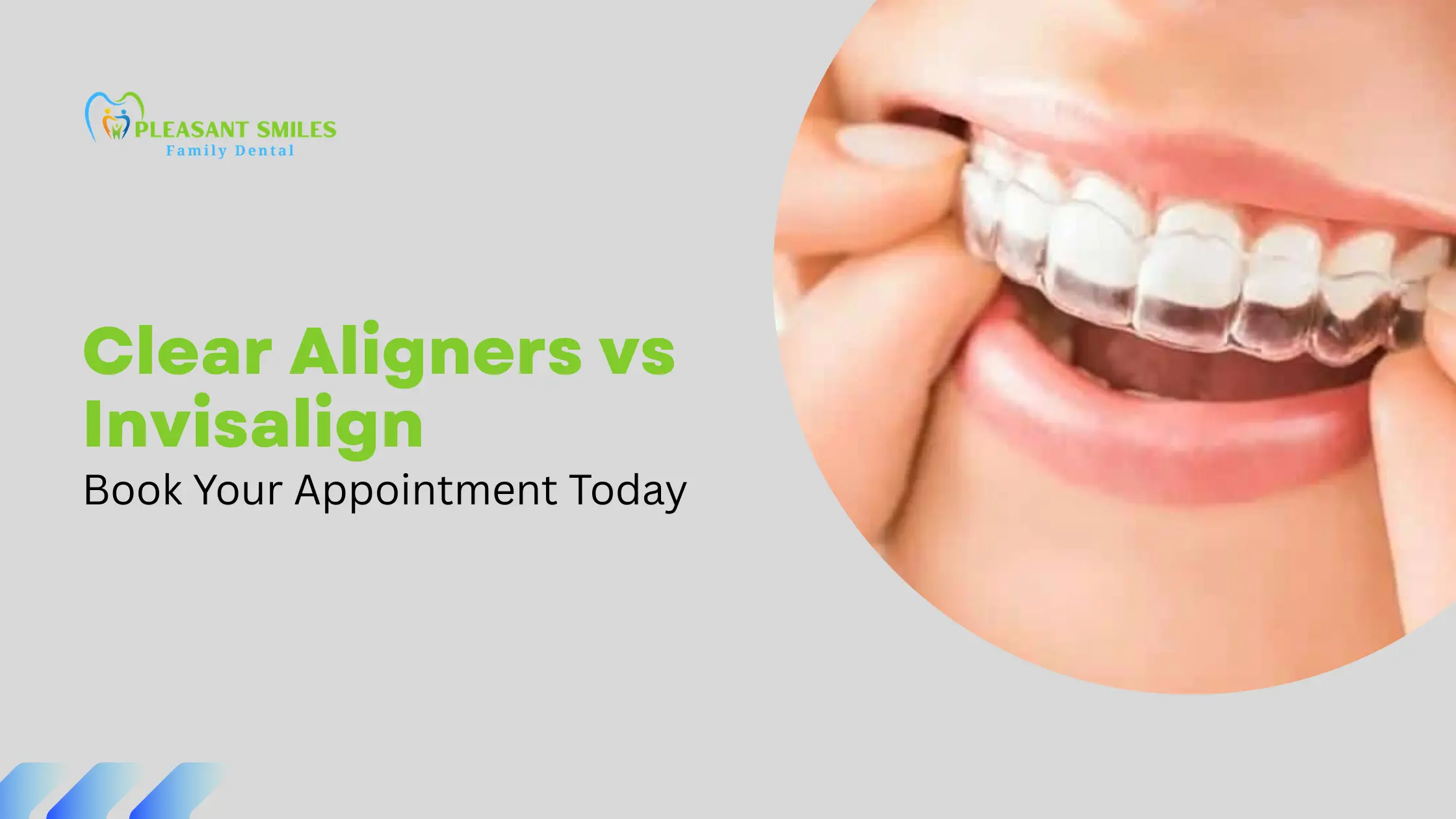
The idea is simple. Your dentist takes a digital scan of your teeth and builds a step-by-step plan to move them. You wear a series of clear trays, and each one shifts your teeth a little closer to the goal.
You switch to a new tray about every one to two weeks, and you wear them 20 to 22 hours a day, taking them out only to eat, drink anything other than water, and brush. Most people finish in about 6 to 18 months, depending on how far the teeth need to move.
Clear Aligners vs Invisalign Price
Cost is usually the deciding factor, so let’s talk honestly about the clear aligners vs Invisalign cost question. Here’s the most important thing to know: there is no single fixed price for any of these treatments.
What you pay depends on how much your teeth need to move, how many trays you need, your provider, and where you live. Any site that quotes you one exact figure is really just guessing, and the only accurate number is a written estimate after an in-person exam.
That said, the options usually rank in about the same order, from most to least expensive, which helps with planning:
| Option | Relative Cost | Supervision |
| Invisalign | Typically the highest | In-office, dentist or orthodontist |
| Traditional metal braces | Comparable to aligners | In-office, orthodontist |
| ClearCorrect | Usually lower than Invisalign | In-office, dentist or orthodontist |
| ClearPath | Usually lower than Invisalign | In-office, dentist or orthodontist |
| At-home (direct-to-consumer) aligners | Lowest upfront | Remote, no in-person exam |
At-home brands look cheaper on paper, and for very mild cases they can be. But that lower price is there because no one checks your teeth in person, and that is exactly where the risk lies. An in-office price includes the planning, check-ups, and adjustments that keep your treatment safe, and that hands-on care is a big part of what you pay for.
It’s also worth checking your benefits. Many dental plans with orthodontic coverage treat clear aligners the same way they treat braces and pay a portion up to a lifetime orthodontic maximum, though coverage for adults is less common than for patients under 18. We’re happy to review your plan with you.
ClearCorrect Aligners vs Invisalign
ClearCorrect is one of the most common Invisalign alternatives offered in dental offices, so it’s worth a closer look. On clear correct aligners vs Invisalign cost, ClearCorrect usually comes in lower than Invisalign.
Much of that difference comes from lab fees, since ClearCorrect charges the dentist less per case than Align Technology does, and part of that saving is typically passed on to you. Beyond price, a few practical differences stand out:
- Material and fit: Invisalign trays use a flexible, snug-fitting material, while ClearCorrect trays are slightly thinner with a low-profile feel.
- Replacements: Invisalign typically includes replacement trays if one is lost; ClearCorrect often charges separately for them.
- Results: For mild to moderate crowding, spacing, and small bite fixes, a skilled dentist can get similar results with either one.
For many everyday cases, the clear, correct aligners vs. Invisalign price gap is the main deciding factor, and both can deliver a great result in the right hands.
Clear Path Aligners vs Invisalign
ClearPath is another option your dentist may offer. It tends to cost less than Invisalign and has a couple of features patients like: many ClearPath cases can be treated without the small tooth-colored bumps that Invisalign often uses, which makes the trays easier to keep clean, and it usually needs fewer check-in visits.
Invisalign still has an edge for harder cases thanks to its planning technology and long track record, but for simple straightening, ClearPath is a solid, more affordable choice.
Clear Aligners vs Invisalign vs Braces
Aligners aren’t always the answer. Here’s how the three main paths compare so you can see where each one fits:
| Feature | Clear Aligners (incl. Invisalign) | Traditional Braces |
| Appearance | Nearly invisible | Visible brackets and wires |
| Removable | Yes, for eating and cleaning | No, fixed to teeth |
| Best for | Mild to moderate cases | Mild to severe and complex cases |
| Comfort | Smooth trays, no wires | Can irritate cheeks and lips |
| Discipline needed | High, must wear 20 to 22 hours daily | Lower, always working |
| Typical cost | Varies by case and provider | Varies by case and provider |
Clear aligners are hard to notice, easy to remove, and comfortable, which makes them a favorite with adults and older teens.
Braces are still the better choice for severe crowding, big bite problems, or badly turned teeth that aligners can’t fully move. The right pick depends on your own bite, not on which one is more popular.
In-Office vs At-Home Aligners: The Difference That Matters Most
This is the part we most want you to understand. The American Dental Association does not recommend direct-to-consumer aligners that skip an in-person exam.
When a dentist supervises your treatment, someone is watching for teeth that aren’t tracking correctly, gum inflammation, or bite issues and can adjust the plan before a small problem becomes a costly one. At-home kits rely on you to catch those things yourself.
There’s also the planning side. In-office Invisalign uses ClinCheck software to map out your whole treatment in 3D, and your dentist reviews it at each step. Most at-home services rely on computer programs with little input from a dentist.
All aligners are FDA Class II medical devices, and as the rules for aligner materials get stricter in 2026, care that a dentist supervises stays the safer, more reliable choice.
Which One Is Right for You?
Use this as a quick check before your consultation:
- Choose in-office aligners (Invisalign, ClearCorrect, or ClearPath) if you want a dentist watching over your care, have a mild to moderate case, and want reliable results.
- Consider braces if your case is complex or needs a major bite fix.
- Be careful with at-home aligners if you have any bite worries, gum issues, or want a dentist checking your progress.
The honest truth is that the best option is the one matched to your teeth by someone who has looked at them. A quick visit and scan tell you far more than any online quiz.
How Pleasant Smiles Can Help
We provide Invisalign and clear aligner treatment right here in Cheshire, CT, for teens and adults. During your consultation, we examine your teeth and bite, explain which options genuinely fit your case, and give you a clear, written cost estimate along with any insurance or financing details.
No pressure and no guesswork, just straight guidance on what will get you the smile you want. If you’ve been wondering whether aligners are right for you, we’d be glad to take a look.
Final Thoughts
When it comes to clear aligners vs Invisalign, the main point is that you’re not really choosing between two different things. Invisalign is just the best-known brand of clear aligner, and options like ClearCorrect and ClearPath can give you similar results at a lower price for the right cases.
What matters far more than the brand name is whether a dental professional who has actually looked at your teeth is guiding your treatment. Get the case right, choose in-person care, and any of these good options can give you a straighter, healthier smile. If you’re in the Cheshire area, come talk it through with us and we’ll help you find the choice that fits your goals and your budget.
Frequently Asked Questions
1. Is Invisalign the same as clear aligners?
Not exactly. Invisalign is a specific brand of clear aligner. Clear aligners are the overall category of transparent trays that straighten teeth, and Invisalign, ClearCorrect, and ClearPath are all brands within it.
2. What is the difference in price between clear aligners and Invisalign?
Invisalign is usually the most expensive option. In-office alternatives like ClearCorrect and ClearPath typically cost less, and at-home direct-to-consumer aligners are cheapest upfront but lack in-person supervision. Exact prices depend on your case, provider, and location, so a consultation is the only way to get an accurate figure.
3. How does ClearCorrect compare to Invisalign on cost?
ClearCorrect usually costs less than Invisalign, largely because of lower lab fees. Results are comparable for mild to moderate cases, though Invisalign often includes replacement trays while ClearCorrect may charge for them separately.
4. Clear aligners vs Invisalign vs braces: which is best?
Clear aligners are best for mild to moderate cases and for people who want a hard-to-notice, removable option. Braces are better for severe or complex cases. The right choice depends on your bite, which is why an exam matters.
5. Are at-home clear aligners safe?
They can work for very mild cases, but the American Dental Association does not recommend aligners ordered without an in-person exam. Dentist-supervised treatment catches problems like poor tracking or gum issues early.
6. How long does clear aligner treatment take?
Most cases take about 6 to 18 months depending on complexity, and aligners must be worn 20 to 22 hours a day for the best results. Your provider will give you a timeline after evaluating your teeth.