


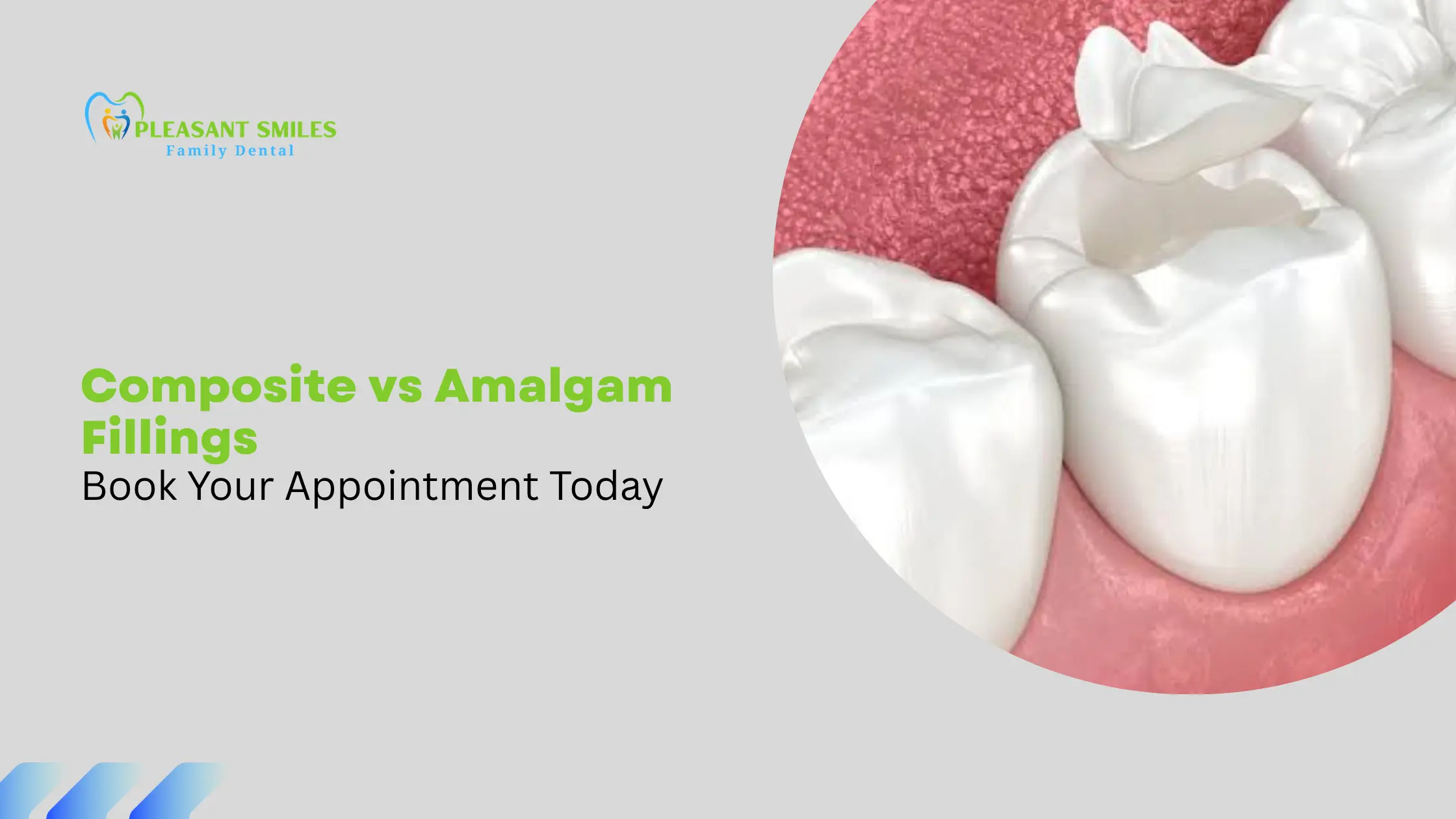
When you discover you have a cavity, choosing between a composite (tooth-colored resin) and an amalgam (silver metal) filling is one of the first decisions you face. While appearance is usually the first thing patients consider, the right material actually depends on the structural condition of your tooth, where the decay is located, and how your bite functions.
Understanding how these materials differ mechanically, clinically, and aesthetically helps you make an informed choice alongside your dentist to protect your long-term oral health.
Quick Comparison: Key Differences at a Glance
| Factor | Composite Resin (Tooth-Colored) | Dental Amalgam (Silver) |
| Material Composition | Plastic resin reinforced with microscopic glass particles | Alloy of silver, tin, copper, and elemental mercury |
| Aesthetics | Matches surrounding tooth shade seamlessly | Dark silver; noticeable when smiling or opening wide |
| Enamel Preservation | Bonds chemically to tooth structure (requires minimal drilling) | Anchors mechanically (requires shaping healthy tooth walls) |
| Moisture Control Needed | High (must remain 100% dry during application) | Moderate (more tolerant in hard-to-isolate areas) |
| Primary Indication | Front teeth, visible areas, small-to-moderate cavities | Large restorations on back molars, high chewing load |
| Mercury Content | 100% Mercury-Free | Contains elemental mercury |
What is a Composite Filling?
A composite filling is a tooth-colored restoration designed to match the precise shade of your natural teeth. The material is made of a durable acrylic resin matrix filled with microscopic glass particles for strength and lustre.
How Composite Restorations Work
- Decay Removal: The decayed enamel and dentin are carefully removed, leaving as much healthy tooth structure as possible.
- Etching and Bonding: A mild etching gel opens microscopic pores in the enamel, followed by a liquid bonding agent.
- Layering & Sculpting: The dentist places the soft composite material in thin layers, shaping it to match the original grooves and cusps of your tooth.
- Light Curing: A high-intensity curing light hardens each layer in seconds.
- Polishing: The restoration is smoothed and adjusted so your bite feels natural.
Advantages of Composite
- Natural Aesthetics: Because shade matching is precise, friends and family will not notice you have had dental work done.
- Conservative Tooth Preparation: Because composite forms a direct chemical bond with tooth enamel and dentin, dentists do not need to hollow out healthy parts of your tooth just to create an anchor space.
- Versatility: Beyond treating cavities, composite resin can repair chipped, cracked, or worn edges on front and back teeth.
Limitations of Composite
Placement requires strict moisture isolation. If saliva or humidity enters the cavity prep while applying the bonding agent, the bond strength decreases, increasing the risk of premature leaks. In addition, extremely large composite fillings on back molars under heavy bite loads may wear down faster than metal over time.
What is an Amalgam Filling?
Dental amalgam, commonly known as a silver filling, is a dark metallic restorative material that dentists have used safely to repair teeth for over 150 years.
How Amalgam Restorations Work
Amalgam is made by mixing powdered silver, tin, and copper with elemental liquid mercury to form a pliable compound.
- Cavity Preparation: Because amalgam does not bond to enamel, the cavity preparation must be shaped with specific undercut angles so the metal stays mechanically wedged inside the tooth once hardened.
- Packing & Carving: The pliable metal is packed tightly into the prepared tooth space, then sculpted to match the anatomy of your bite.
- Hardening: Amalgam sets through a chemical hardening reaction without requiring a curing light.
Advantages of Amalgam
- Exceptional Structural Durability: Amalgam withstands massive chewing pressure, making it useful for large restorations on back molars.
- Moisture Tolerance: It is more forgiving during placement in areas below the gumline or deep in the back of the mouth where keeping a tooth completely dry is difficult.
- Cost-Effectiveness: Amalgam materials cost less to manufacture and place, making them an economical choice for extensive repairs.
Limitations of Amalgam
The primary drawback is visual. Over time, amalgam can also darken the natural tooth around it, creating a slight grayish shadow. Additionally, because metal expands and contracts with temperature changes (hot coffee, cold water), old amalgam fillings can occasionally exert internal pressure on tooth walls, leading to micro-cracks over many years.
Composite vs Amalgam Fillings: What’s the Difference?
| Factor | Composite fillings | Amalgam fillings |
| Appearance | Tooth-colored and can blend with natural teeth | Silver-colored |
| Material | Resin with glass filler | Mercury combined with a metal alloy |
| Tooth preparation | Often allows preservation of more healthy tooth structure | Preparation may require a different cavity design |
| Strength | Strong and suitable for many restorations | Strong and wear-resistant |
| Large back-tooth fillings | May be appropriate depending on the tooth and restoration | Can be useful where chewing forces are high |
| Moisture control | Requires good moisture control during placement | More forgiving when moisture is difficult to control |
| Cost | Usually costs more | Generally less expensive |
| Cosmetic appearance | Excellent | Limited because of the silver color |
| Mercury | Does not contain mercury | Contains elemental mercury |
| Existing filling | Can be repaired or replaced when clinically appropriate | A healthy amalgam filling doesn’t automatically need replacement |
The material is only part of the decision. The condition of the tooth matters just as much.
Which Material Lasts Longer?
Patients often ask whether silver or white fillings last longer. Large systematic reviews comparing composite and amalgam restorations in back teeth show no statistically significant difference in overall failure rates between modern composite materials and traditional amalgam.
Instead of the material alone, the real lifespan of any filling depends on:
- The Size of the Decay: Small cavities repaired early last significantly longer than large restorations covering multiple tooth surfaces.
- Bite Pressure & Habits: Heavy clenching or nighttime teeth grinding (bruxism) places excess stress on both composite and amalgam restorations.
- Oral Hygiene: A filling only seals the internal cavity; new decay can still form on natural tooth structure around the edges of an old filling if plaque accumulates.
- Regular Dental Exams: Catching minor marginal wear during routine cleanings allows your dentist to smooth or repair a filling before it breaks completely.
Signs You Might Need a Tooth Filling
Cavities develop quietly and often cause no pain in their early stages. You should schedule a professional examination if you experience any of the following:
- Sensitivity or sharp discomfort when consuming hot, cold, or sweet foods
- Mild, localized pain when biting down or chewing
- A visible dark spot, discoloration, or small hole on a tooth surface
- Dental floss catching or tearing repeatedly between the same two teeth
- A rough edge that your tongue keeps picking up on
Regular dental checkups and diagnostic X-rays allow decay to be caught and treated while a simple, conservative filling is still possible.
FDA Guidelines on Amalgam and Mercury Safety
Because amalgam contains elemental mercury, questions about its safety are common.
The FDA notes that dental amalgam releases minute amounts of mercury vapor over time. While amalgam remains an accepted dental material, the FDA recommends that non-amalgam options (such as composite resin) be considered for higher-risk groups when clinically appropriate:
- Children younger than 6 years old
- Women who are pregnant, planning to become pregnant, or nursing
- Individuals with pre-existing kidney conditions or neurological disorders
- People with documented allergies or sensitivities to mercury or metal alloys
Should You Replace Sound Silver Fillings?
No. The FDA explicitly advises against removing intact amalgam fillings simply because they contain mercury. Drilling out a healthy, working silver filling destroys sound natural enamel and temporarily increases mercury vapor exposure during the removal procedure. An amalgam filling should only be replaced if active decay forms underneath it, if the restoration fractures, or if there is a clear clinical reason to restore the tooth.
Are Tooth-Colored Fillings Worth the Higher Price?
Yes. The higher price reflects long-term structural and aesthetic advantages:
- Preserves Healthy Enamel: Composite bonds chemically directly to the tooth. Dentists remove only the decayed tissue. Amalgam requires drilling extra undercut channels into sound enamel so the metal wedging stays locked in place.
- Invisible Restorations: Composite resin is custom shade-matched to surrounding teeth, leaving no visible metal lines when talking or laughing.
- 100% Metal and Mercury-Free: Composite offers a biocompatible option for patients seeking non-metal restorations.
If you need to treat a large cavity on a hidden back molar where aesthetics are not a concern, amalgam remains an economical, durable alternative.
What to Expect During Your Visit at Pleasant Smiles Family Dental
At Pleasant Smiles Family Dental, Dr. Vijitha Bandla takes a gentle, personalized approach to restorative care. We ensure you feel completely comfortable, informed, and involved in your treatment decisions every step of the way.
- Comprehensive Examination: We use high-resolution digital imaging to evaluate the exact depth and boundaries of the cavity.
- Painless Preparation: We apply a topical numbing gel followed by local anesthesia so you remain relaxed and pain-free throughout the procedure.
- Precise Restoration: Dr. Bandla removes the decay, sanitizes the tooth, and carefully places your chosen restorative material to match your natural bite contour.
- Bite Testing: We check your bite alignment to make sure chewing feels completely natural and comfortable before you leave.
Restoring Your Smile in Cheshire, CT
If you believe you are suffering from tooth decay or a cavity, or need a clinical evaluation of an existing filling, we are here to help you choose the best option for your health and comfort.
Pleasant Smiles Family Dental
📍 Address: 1090 Meriden-Waterbury Turnpike, Suite 2, Cheshire, CT 06410
📞 Phone: (860) 426-0997
Schedule Your Dental Evaluation Online
Composite vs Amalgam Fillings FAQs
1. What is the difference between composite and amalgam fillings?
Composite fillings are tooth-colored restorations made from resin and glass filler. Amalgam is a metal alloy that contains elemental mercury along with silver, tin, and copper. Composite provides a more natural appearance, while amalgam has a long history of strength and durability, particularly in certain back-tooth restorations.
2. Are composite fillings better than silver fillings?
The better material depends on the tooth and the restoration. Composite is usually preferred when a natural appearance is important. Amalgam can be useful for certain large restorations and areas exposed to heavy chewing forces.
3. Are silver amalgam fillings safe?
Dental amalgam remains an accepted restorative material. The FDA does recommend that certain higher-risk groups consider non-amalgam alternatives when appropriate. If you already have an intact amalgam filling, the FDA does not recommend removing it simply because it contains mercury.
4. Can you put a composite filling on a back molar?
Yes. Modern micro-hybrid composites are engineered to handle high chewing loads on premolars and molars. For small to moderate cavities, composite provides a durable, natural-looking restoration. However, if decay has destroyed a major portion of the molar’s chewing surface, a porcelain crown may be recommended to provide full structural protection.
5. Are white fillings more expensive than silver fillings?
Composite fillings generally cost slightly more than amalgam due to the advanced bonding technology, specialized materials, and precise technique required. Most dental insurance plans cover composite restorations on both front and back teeth, though coverage rules vary. Our team provides clear cost estimates before any treatment.
